
If you have been living with a PCOS diagnosis, you may have recently seen something surprising in the news. The condition that 1 in 8 women live with worldwide has officially been renamed. And this is not just a cosmetic update to a label.
In May 2026, after 14 years of global research involving over 22,000 patients, clinicians, and researchers across six continents, The Lancet published a landmark consensus statement officially renaming PCOS to PMOS: Polyendocrine Metabolic Ovarian Syndrome. Over 56 global organisations backed the change.
For the 170 million women living with this condition worldwide, and the estimated 70% who remain undiagnosed, this moment matters. Not because your body changed overnight. Because the way the medical world understands it finally has.
Why Was PCOS Renamed to PMOS?
The old name had one fundamental problem. It was quietly misleading every woman who had it.
The word "cystic" suggested ovarian cysts were the defining feature of the condition. But what actually appears on an ovarian ultrasound is not cysts at all. They are small, immature follicles — eggs that never fully developed. Nearly 25% of perfectly healthy women show these on their ovaries, and they mean nothing on their own.
This caused two real, damaging problems. Countless women were told they did not have PCOS simply because their ultrasound looked normal, even when every other signal in their body pointed directly to it. And just as many were handed a diagnosis purely on the basis of a scan, without any other supporting evidence.
The PCOS renamed PMOS decision followed patient surveys from 2017, 2023, and 2025. The three things people needed most from a new name were accuracy, reduced stigma, and a name that reflected what they were actually experiencing. After 14 years, that name is here.
What Does PMOS Stand For?
Each word in polyendocrine metabolic ovarian syndrome is deliberate. Here is what they actually mean.
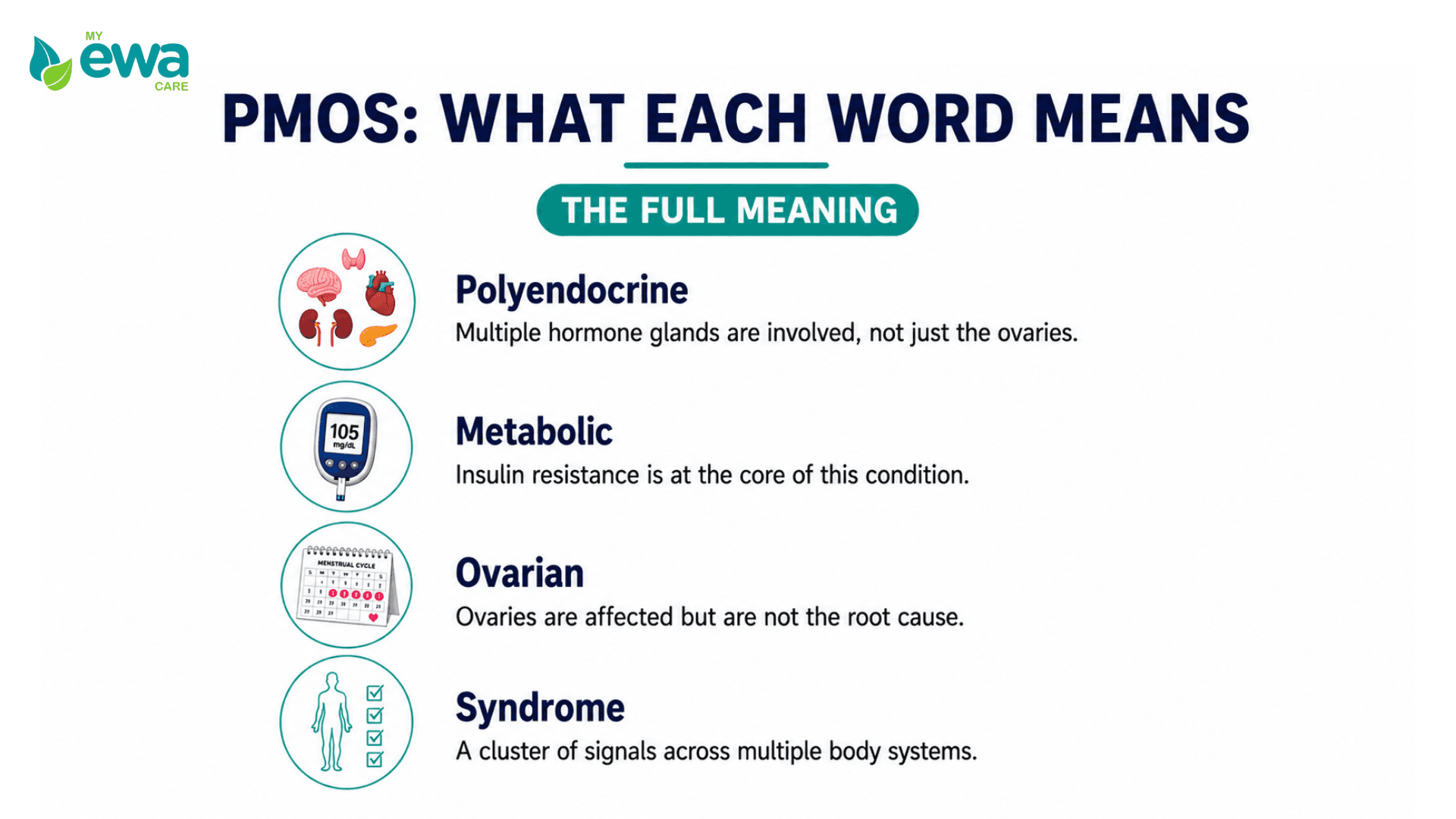
Polyendocrine — Multiple hormone-producing glands are involved, not just the ovaries. Your thyroid, adrenal glands, and insulin-producing pancreas are all part of this picture. For years, women were referred to a gynaecologist and told it was an ovarian problem. The new name makes clear that it never was only that.
Metabolic — This is the most significant word in the entire name. Insulin resistance is now recognised as central to this condition, not a side effect. For Indian women especially, where genetics and diets high in refined carbohydrates increase metabolic vulnerability, this changes what the very first conversation with a doctor should look like.
Ovarian — The ovaries are still involved. Irregular cycles, disrupted ovulation, and elevated androgens remain real and relevant. But the ovaries are now understood as a site where the condition expresses itself, not where it originates.
Syndrome — PMOS is a cluster of signals across multiple body systems, not a single disease with a single fix. This framing is important because it sets the expectation that a whole-body lens is needed, not a single-specialty one.
PCOS vs PMOS: What is the Actual Difference?
The condition itself has not changed. Your body has not changed. What has changed is the framework doctors are now expected to work within.
Under the PCOS model, many women were handed a contraceptive pill prescription to regulate periods, sometimes without any investigation into why cycles were disrupted in the first place. Symptoms were addressed on the surface. Root causes were rarely the starting point.
The PCOS vs PMOS difference is really about what your diagnosis should now open up. Under PMOS, your insulin levels, blood glucose, cholesterol, and cardiovascular picture should be central to the initial assessment, not extras you have to request.
For Indian women who felt the PCOS conversation only ever told half the story, that instinct was right.
Does My PCOS Diagnosis Change Now That PMOS is Official?
No. And this is worth saying clearly because it is the question most women are searching right now.
If you were diagnosed with PCOS last month, last year, or ten years ago, your diagnosis remains completely valid. You now simply have PMOS. Your existing blood work, scan reports, and clinical history do not need to be repeated.
What this moment does give you is a genuine opening. Use it to ask whether your metabolic health has ever been properly evaluated alongside your hormonal picture. Have your insulin levels, fasting glucose, or lipid profile been assessed? If not, this is the right time to raise that question.
If you are still working through irregular periods or hormonal symptoms and looking for where to begin, our earlier guide on understanding irregular periods causes and reclaiming your cycle walks through the early steps without the panic or the expensive testing loop.
How is PMOS Diagnosed?
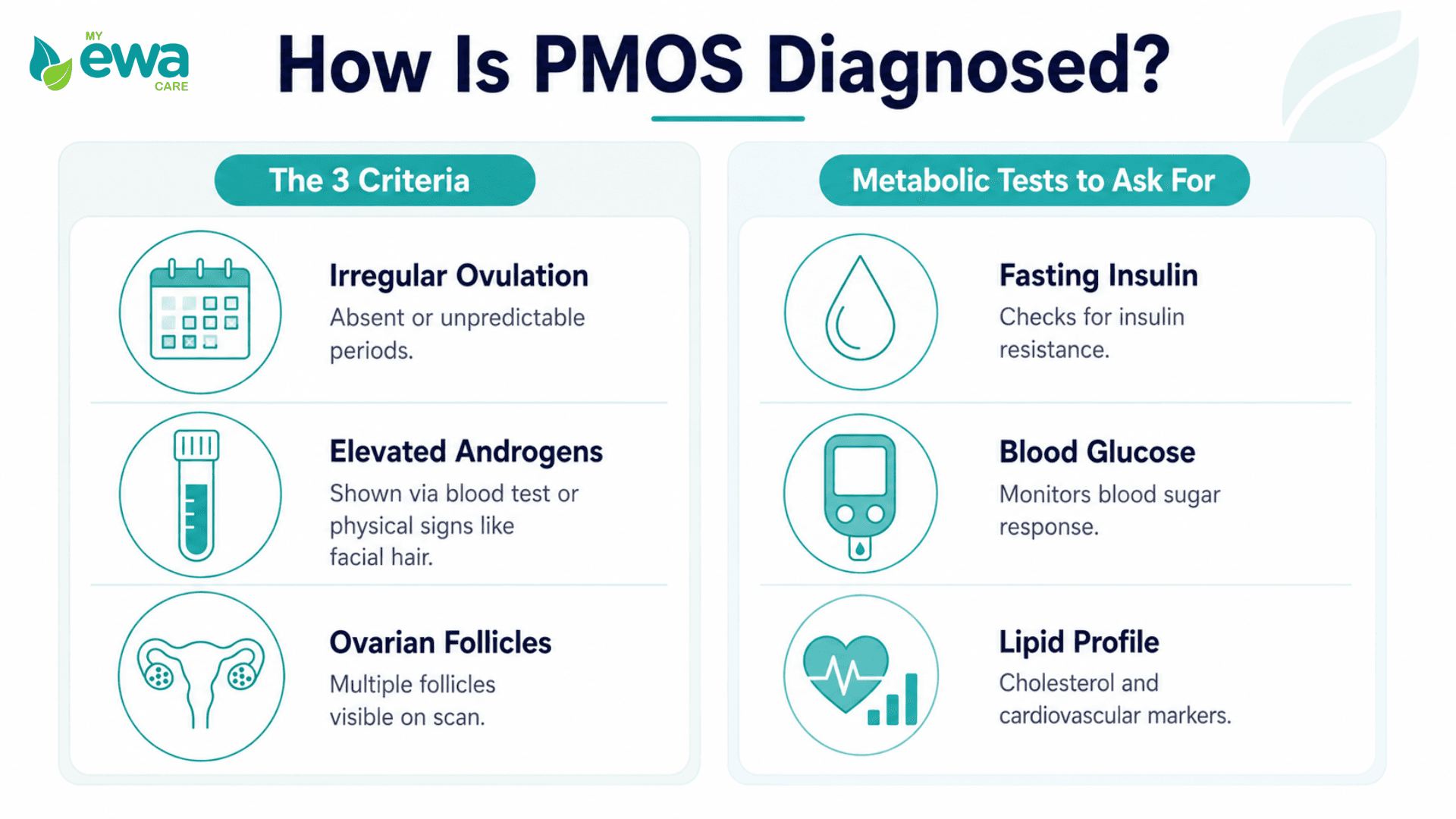
The PMOS diagnosis criteria are the same as the Rotterdam criteria that were used for PCOS. A diagnosis is confirmed when at least two of the following three features are present:
Irregular or absent ovulation
Elevated androgen levels, either through a blood test or visible signs like facial hair or persistent acne
Multiple follicles visible on an ovarian ultrasound
What has changed is not the criteria, but what should happen next. A PMOS diagnosis should now be the starting point for a broader metabolic evaluation, including:
Fasting insulin and blood glucose levels
Lipid profile and cholesterol
Blood pressure
Thyroid function
These were rarely the first things assessed under the old PCOS framework. Under PMOS, they should be part of the picture from the beginning.
One important note: the ultrasound is not the deciding factor and should never be treated as one. A scan alone, without supporting clinical signs, is not sufficient grounds for a PMOS diagnosis. If you have ever felt like your diagnosis was based primarily on what a scan showed, that is a conversation worth revisiting.
Symptoms of PMOS: What to Watch For
The symptoms of PMOS are the same as what were known as PCOS symptoms. What has changed is how they are now understood, as a coordinated set of signals from a whole-body endocrine and metabolic system, not a random list of unrelated complaints.
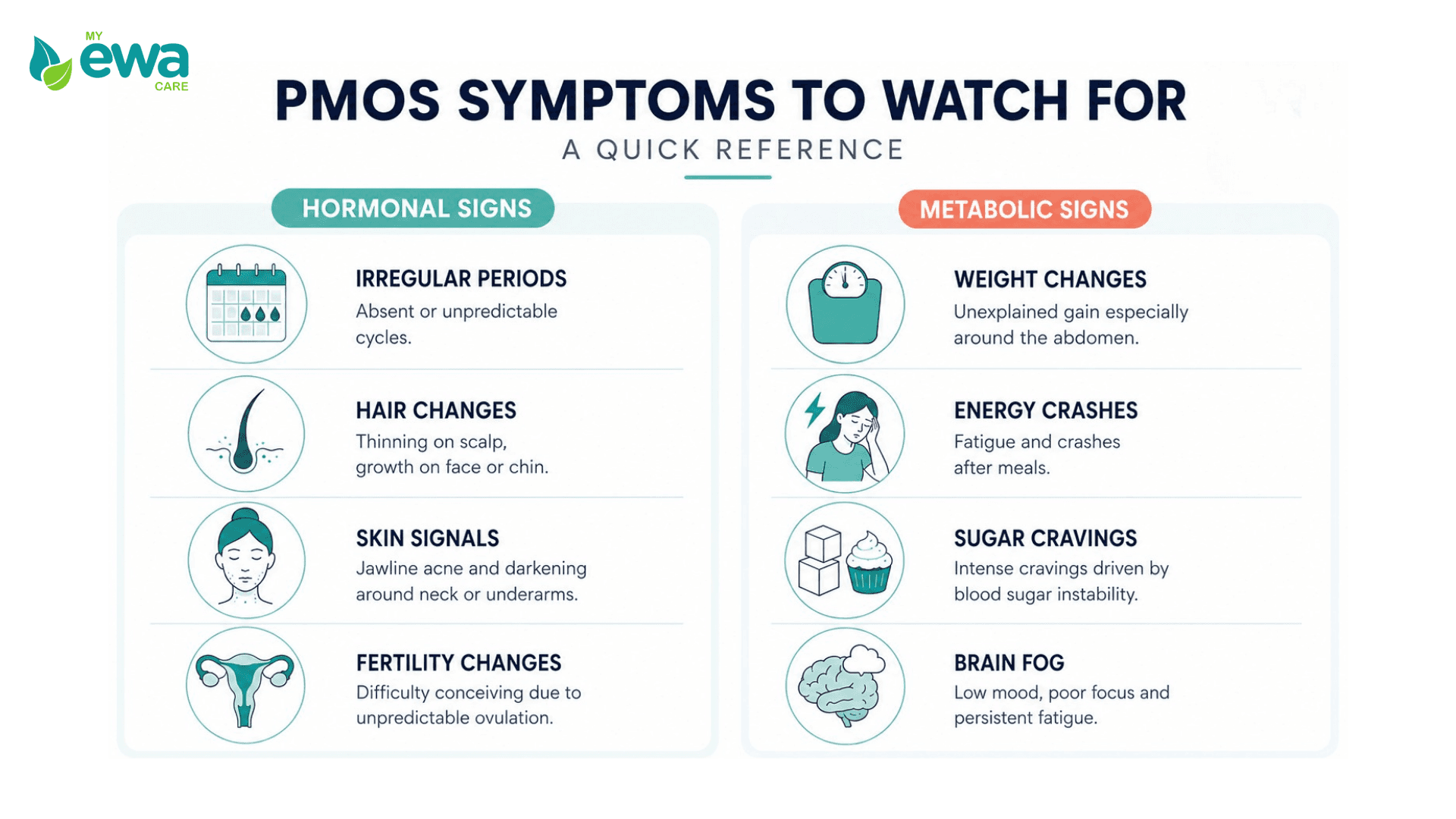
Common PMOS symptoms include:
Irregular or absent periods
Unexplained weight changes, particularly around the abdomen
Thinning hair or significant hair fall
Unwanted hair growth on the face, chin, or chest
Persistent acne, especially along the jawline
Skin darkening around the neck, underarms, or groin
Energy crashes after meals and intense sugar cravings
Difficulty conceiving
Low mood, brain fog, or persistent fatigue
In India, many of these get dismissed as stress, diet, or simply "your body type." Fatigue gets attributed to the heat. Hair fall gets blamed on hard water. Irregular periods get normalised. The PCOS name change to PMOS does not change these experiences. It does strengthen the case for taking them seriously rather than waiting for them to resolve on their own.
If several of these feel familiar, your body is asking for clarity. That is not a cue to panic or to book every available scan. It is a reason to seek independent guidance and understand your own picture before committing to anything clinical.
The Insulin Resistance Connection: Why This is the Missing Piece
If there is one area where the shift to PMOS has the most practical impact for Indian women, it is the insulin conversation.
When the body struggles to respond efficiently to insulin, it produces more to compensate. That excess insulin signals the ovaries to produce more androgens, which are the hormones behind many of the most visible PMOS symptoms: facial hair, scalp hair loss, acne, weight that resists change, and disrupted cycles. This is a metabolic chain reaction, not a random collection of unrelated problems.
Metformin, which supports insulin sensitivity, has been used for PCOS for years, but it was often positioned as a secondary option rather than an early one. Under PMOS, the metabolic conversation, including whether lifestyle shifts or medications like metformin are appropriate, should happen at the beginning rather than after other avenues have been exhausted.
In everyday terms, here is what supporting your metabolic health can look like:
Eat to keep blood sugar steady: millets, lentils, vegetables, and adequate protein over refined carbohydrates
Choose movement that builds: walking and gentle strength training support insulin sensitivity better than exhausting high-intensity sessions that spike cortisol
Protect your sleep: poor sleep directly worsens insulin resistance regardless of how well you eat
Address stress deliberately: elevated cortisol compounds the hormonal picture and is not a soft concern
PMOS and Fertility: What the Name Change Means if You are Trying to Conceive
PMOS does not mean you cannot conceive. Many women with this condition do conceive naturally, and the new framework is actually more helpful for fertility, not less.
Unpredictable ovulation can make timing more complex. But the metabolic lens PMOS brings to the conversation focuses attention on foundational factors first: blood sugar regulation, hormonal balance, and cycle patterns. If ovulation is being disrupted because of insulin resistance, that is where the conversation should begin. Understanding what is driving the irregularity before making any clinical decisions is far more useful than acting under the pressure of a diagnosis alone.
PMOS fertility concerns are often compounded by the speed at which women are moved toward clinical steps without a clear picture of what is actually happening in their body. Getting that clarity first is not delay. It is the most informed path forward.
Will My Doctor Still Say PCOS? Understanding the 3-Year Transition
Almost certainly yes, for a while, and that is completely normal.
Medical records, insurance codes, clinical guidelines, and hospital systems take time to update. A transition period of approximately three years has been acknowledged, meaning both PCOS and PMOS will be used interchangeably through 2027 and into 2028. Seeing PCOS on a prescription or lab report does not mean your doctor is uninformed.
What you can do is use the name PMOS yourself. Raising it in a consultation opens a different, more complete conversation from the start. It signals that you understand the metabolic dimension and are looking for a care approach that reflects it.
Questions to Ask Before Your Next Appointment
Going into a consultation prepared changes what you walk out with. Here are the questions worth raising:
Have my insulin levels and fasting blood glucose ever been evaluated alongside my hormonal picture?
Is an ultrasound actually necessary right now, or can we monitor my symptoms across one full cycle first?
What does a proper metabolic assessment for PMOS look like in my case?
Is an insulin-sensitising approach, including whether metformin is relevant, worth discussing for me?
How will this change my day-to-day, and what should I genuinely be watching for?
If a prescription or procedure is being suggested, what happens if I choose to observe for one more cycle before deciding?
Speak to a Care Manager before your next healthcare step. Getting clarity before you commit to a clinical pathway saves both stress and unnecessary expense.
Frequently Asked Questions About PMOS
What is PMOS and how is it different from PCOS?
PMOS stands for Polyendocrine Metabolic Ovarian Syndrome. It is the official new name for what was called PCOS. The condition is unchanged, but the name now accurately reflects that this is a whole-body endocrine and metabolic condition, not primarily an ovarian disease.
Why was PCOS renamed to PMOS in 2026?
The old name was medically misleading. The follicles seen on an ovarian ultrasound are not cysts, and many women with the condition have no ovarian findings at all. After 14 years of research and input from over 22,000 people across six continents, the name was updated to reflect the true metabolic and endocrine nature of the condition.
What are the PMOS diagnosis criteria?
The same as the Rotterdam criteria used for PCOS. At least two of three features must be present: irregular ovulation, elevated androgens, or multiple ovarian follicles on ultrasound. A metabolic evaluation should now accompany the standard hormonal assessment from the beginning.
Does my PCOS diagnosis change now that PMOS is the official name?
No. Your existing diagnosis, history, and reports remain completely valid. You now have PMOS. Nothing about your body has changed.
What does polyendocrine mean in plain terms?
It means multiple hormone-producing glands are involved, not just the ovaries. Your thyroid, adrenal glands, and insulin-producing pancreas are all part of the picture.
Is metformin still relevant for PMOS?
Yes. Metformin supports insulin sensitivity and remains relevant under PMOS. The difference is that the insulin conversation should now happen earlier and more consistently than it did under the PCOS model.
Can women with PMOS conceive naturally?
Yes, many do. Understanding your full metabolic and hormonal picture is a far more useful and empowering starting point than rushing toward clinical steps.
Will my doctor use PMOS or PCOS?
Both names will be used during a transition period of approximately three years. You may still see PCOS on prescriptions and reports through 2027 or 2028 as medical systems globally update their records and guidelines.